Diving and
Snorkeling in Florida
Florida is home to more divers, more
dive stores and more
dive boats than any other dive destination!
More divers visit Florida every year than any other dive destination!
With over 1,300 miles of coastline and thousands of rivers, lakes and
springs, Florida has more dive sites — and a greater diversity of dive
sites — than any other dive destination.
Florida Dive Regulations
Diver Down Flag
- State law requires that scuba divers or snorkelers display a flag
whenever they are in the water.
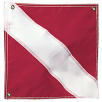 The
"diver down" flag is a square or rectangular red flag (if on boats, at
least 20 inches by 24 inches; at least 12 inches by 12 inches on towed
buoys) with a white diagonal stripe and with wire or other stiffener to
hold it unfurled and extended. The
"diver down" flag is a square or rectangular red flag (if on boats, at
least 20 inches by 24 inches; at least 12 inches by 12 inches on towed
buoys) with a white diagonal stripe and with wire or other stiffener to
hold it unfurled and extended.
Boaters must make
reasonable efforts to stay 300 feet away from dive flags in open water;
100 feet in rivers, inlets and navigation channels.
Boaters approaching diver
down flags closer than 300 feet in open water and 100 feet in rivers,
inlets and navigation channels must slow their vessels to the minimum
speed required to maintain forward motion and steering.
Great Dive
and Snorkeling Destinations
Panhandle - the best places in Florida to explore historic wrecks.
There are several vessels in the area, including a World War I
battleship and a retired aircraft carrier. In Panama City the marine
institute has sunk ships, including a 465-foot British tanker 20 miles
off Cape San Blas. Pensacola is home to the "World's Largest Artificial
Reef" The retired aircraft carrier
Oriskany arrived safely to Naval Air Station Pensacola from
Beaumont, Texas in 2006 and it was reefed on May 17, 2006 with
controlled charges in 212 feet of water 24 miles southeast of Pensacola
Pass.
For snorkeling, try Fort Pickens State
Park, at slack tide. Look for horse conchs, manta rays and turtles at
the rock jetties.
Florida Keys - Key Largo is probably Florida's best place to
explore big wrecks. The 510-foot Spiegel Grove is probably the
highlight, followed by two other great wrecks not to be missed - the
former Coast Guard cutters Bibb and Duane. Toothy fish like barracuda
and oceanic jacks have made these sites their home base.
Cental Florida - Divers who visit the Sebastian won't want to miss
Mel Fisher's Treasure Museum
on US 1 in downtown Sebastian. The shop displays treasures from
different wrecks including the famous Atocha. There are jewels
and gold bars on display as well as for sale.
Scuba Diving & Snorkeling Safety
Diving is a popular sport and divers
can be found in areas shared with recreational boaters. As its
popularity increases, it becomes more important for both boaters and
divers to take special precautions.
As A Dive Boat Operator, You Should:
Be able to recognize a "diver
down" flag, a red flag with a white diagonal stripe floating in the area
of the divers. Follow the diver down flag regulations.
Stay the legal distance away from a diver down
flag. Scuba divers or snorkelers should not place the flag where it will
obstruct traffic or create a hazard to navigation on a river, inlet or
navigation channel. In open waters, divers must make reasonable efforts
to stay within 300 feet of their diver down flag; in rivers, inlets and
navigation channels, 100 feet. the diver down flag must be removed when
scuba divers or snorkelers are not in the water.
Keep a lookout for bubbles breaking the surface of the water. The
bubbles indicate that there are divers below who may have strayed from
their marked diving area.
|
Photo by Elaine Blum
Who to Call for Help
The U.S. Coast Guard is the primary
contact for notification of all offshore medical emergencies. Contact
them via channel 16 on VHF radio. they may dispatch a vessel to provide
initial emergency medical assistance at sea or to provide an escort to a
dock where medics and an ambulance can be waiting. Be prepared to
provide the following information:
● Your vessel's name and its description
● The exact nature of the problem
● Your location (GPS coordinates)
● Any landmarks
● Sea conditions/currents
● Description of diver; age, color of gear
About the Bends
The bends, or decompression sickness, is a dangerous, sometimes
deadly, condition in which nitrogen gas bubbles form in the tissues and
blood vessels of divers who have ascended too quickly from the deep.
Stricken divers often stoop over in pain - a stance that led to it being
called "the bends." Victims are treated by being placed in a pressurized
chamber that delivers 100 percent oxygen. The nitrogen bubbles are
removed as the increased level of oxygen enters the blood and body
tissues.
Florida Lobster Season
Regular lobster season in Florida is August 6 thru March 31. The
bag limit is six lobster per day.
In
order to secure their own safety, divers should:
●
Always display the diver down flag.
●
Select a boat that is suited for diving. A
small boat is best, though it should be large enough to comfortably hold
diving gear, while allowing room for easy exit and entry. It should also
be stable. Flat bottom boats should be considered for this reason.
●
Avoid overloading the boat with people or
equipment and supplies.
●
Always anchor the boat securely.
 
Some text on this page
provided by the Florida Fish and Wildlife Conservation Commission.
|