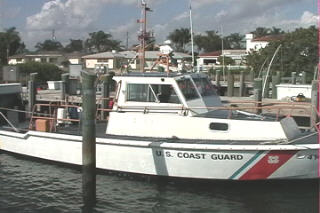
Boating Safety
Minimum Florida State Boating Requirements
Follow
this link
for a list of the equipment and lighting you MUST have on your
boat when operating in the state of Florida.
Florida
Marine Patrol
The Florida Marine Patrol is
now known as the
Fish and Wildlife Commission (FWC). Their main phone number is:
850-488-4676
Regional Offices:
Northwest Region -
Regional Office - Panama City - 850-265-3676
North Central Region -
Regional Office - Lake City - 386-758-0525
Northeast Region -
Regional Office - Ocala - 352-732-1225
Southwest Region -
Regional Office - Lakeland - 863-648-3200
South Region -
Regional Office - West Palm Beach - 561-625-5122
Boating Safety Education
Requirements
Anyone born on or after January 1, 1988
who operates a vessel powered by 10 horsepower or more must pass an
approved boater safety course and have in his/her possession
photographic identification and a boating safety education
identification card issued by the Florida Fish and Wildlife Conservation
Commission.
This online boating safety
course is approved by the Florida Fish & Wildlife Conservation
Commission. Successfully completing this course will allow you to obtain
the official Florida Boating Safety Education ID Card. The boating safety course and exam are
free - you only pay when you pass!
Click HERE to take the
course
Florida Department of Environmental Protection
The Department of
Environmental Protection is the lead agency in state government for
environmental management and stewardship and is one of the more
diverse agencies in state government, protecting our air, water, and
land. The Department is divided into three primary areas: Regulatory
Programs, Land and Recreation, and Policy and Planning. Florida's
environmental priorities include restoring America's Everglades,
improving air quality, restoring and protecting the water quality in
our springs, lakes, rivers and coastal waters, conserving
environmentally-sensitive lands and providing citizens and visitors
with recreational opportunities, now and in the future. If you
see illegal dumping (black water tank from a boat, hazardous waste,
etc.), call the Broward County Environmental Protection Complaint
Hotline and they will refer you to the proper authority to report
the incident to: Call 954-519-1499.
Tips for Safe Boating
No matter how many years you've
been around boats, please take just 5 minutes to scan this safety
information. People who hunt or fish from boats have one of the highest
boat fatality rates. More die from falling off boats 16 feet and smaller
than larger boats, and most boats are anchored at the time.
Free Vessel Safety Check
Are you unsure about the proper and
current equipment needed on your boat? The United States Sail & Power
Squadron and the Coast Guard Auxiliary offer a free vessel safety check
of your boat, while it's in the water or on the trailer. For a FREE
Vessel Safety Check of your craft, any type, where it is located, visit
the
National Department of Vessel Safety
Checks
to find a Coast Guard Auxiliary Vessel Safety Check Examiner in your
area.
Safety Equipment Requirements
Class A (less than 16 ft)
Class 1 (16 to less than 26ft)
Class 2 (26 to less than 40ft)
Class 3 (40 to less than 65ft)
Old Flares and Hazardous Wastes
Where can boaters take
out-of-date flares and other hazardous wastes? (Including old gasoline,
used batteries, paint and cleaning solvents, Methylene chloride paint
stripper and bilge pump switches containing Mercury) In Palm Beach
County the Household Hazardous Waste Collection Center is at the
landfill on Jog Road just north of 45th Street in West Palm Beach. They
are open Monday thru Friday from 8:00 a.m. to 5:00 p.m. Call 687-1100.
Do not throw old flares in the trash or water. Do not fire off old
flares on the 4th of July or during other holiday events! Soaking flares
in water is not a good disposal option since some flares react when
exposed to water.
Boating Rules of the Road
On the water, the stand-on (privileged)
boat has the right-of-way. The give-way (burdened) boat must give way.
At night, running lights provide information about size, direction, and
speed of the other vessel.
Rip
Currents
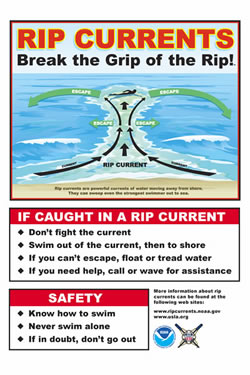 Rip currents are powerful, channeled currents of water flowing away
from shore. They typically extend from the shoreline, through the surf
zone, and past the line of breaking waves. Rip currents can occur at any
beach with breaking waves, including the Great Lakes.
Rip currents are powerful, channeled currents of water flowing away
from shore. They typically extend from the shoreline, through the surf
zone, and past the line of breaking waves. Rip currents can occur at any
beach with breaking waves, including the Great Lakes.
Rip currents can be killers. The United
States Lifesaving Association estimates that the annual number of deaths
due to rip currents on our nation's beaches exceeds 100. Rip currents
account for over 80% of rescues performed by surf beach lifeguards.
The greatest safety precaution that can
be taken is to recognize the danger of rip currents and always remember
to swim at beaches with lifeguards. The United States Lifesaving
Association has calculated the chance that a person will drown while
attending a beach protected by USLA affiliated lifeguards at 1 in 18
million. If caught in a rip current at an unguarded beach, how you
respond could make the difference between life and death.
How to Safely Trailer Your Boat
The Towing Capacity Guide
makes it easy for you to find the right match between vehicles and
towables such as boats, campers, horse trailers, motorcycles and other
recreational equipment.
Used Oil
Most marinas accept used oil for recycling. If not, call
this toll free number and enter your zip code or leave a message to
locate the nearest public used oil collection center: 1-800-741-4337.
|
U.S. Coast Guard
Florida is in District 7 of the
United States Coast Guard. There are 4 Sectors in this District:
Sector St Petersburg
155 COLUMBIA DR
TAMPA, FL 33606
Primary Phone: 813.228.21921 X 8108
Emergency Phone: 727.824.7506
Fax Number: 813.228.2050
Website
Sector Key West
100 TRUMBO POINT ANNEX
KEY WEST, FL 33040
Primary Phone: (305)292-8809
Emergency Phone: (305)292-8727
Fax Number: (305)292-8739
Website
Sector Miami
100 MACARTHUR CAUSEWAY
MIAMI BEACH, FL 33139
Primary Phone: 305-535-8700
Emergency Phone: 305-535-4472/4473
Fax Number: 305-535-8761
Website
Sector Jacksonville
4200 OCEAN STREET
ATLANTIC BEACH, FL 32233
Primary Phone: (904) 564-7500
Emergency Phone: (904) 564-7511/12
Fax Number: (904) 564-7519
Website
Local Notice to Mariners
Safe
Boating Tools
It's always a good idea to have
Charts & Maps of the areas you plan to boat in. Lessons on
how to boat
or
how to sail are also highly recommend for the new mariner. NOAA now
offers a way to access, download and print the latest Raster Navigation
Charts. Each chart is presented as a set of letter-size pages that can
be printed from your computer.
Download charts
Homeland Security
Boaters in South Florida and across the
state are encouraged to call a new hotline (877) 24-WATCH, to
report any potential terrorist activities. The list of criteria to be on
the lookout for includes suspicious people who photograph or make
sketches of unusual places, probe waterways with rented watercraft, sell
or deliver illegal merchandise, or ask unusually detailed questions
about specific areas. If you suspect any terrorist activity or have
questions regarding Operation On Guard, call your local Coast Guard
Station or the new hotline.
Hypothermia
Exposure causes loss of body heat. This is
called hypothermia. Hypothermia can kill. Defense against hypothermia is
to avoid exposure to cold. Do this by staying dry and avoiding the wind.
Put on rain gear before you get wet. If you fall into cold water do NOT
discard clothing; it will help trap heat. Avoid moving as much as
possible. A
life jacket
helps in two ways. It helps with floatation and it helps to insulate against heat loss. When you wear a
life jacket, draw knees up into a H.E.L.P. (Heat Escape Lessoning
Position). If several persons are in the water, huddle together so you
can conserve heat and stay alive. Treatment involves getting the victim
out of cold producing environment. Strip off all wet clothing and get
person into a warm sleeping bag. Try to keep person awake. Do NOT give
alcohol or massage vigorously. Giving the person warm drinks or food is
not a good idea. They don't help re-warm the person and they can pose a
choking hazard. Transport the victim to a hospital as soon as possible.
|
Hypothermia Chart |
If the water
temp (F) is... |
Exhaustion or unconsciousness |
Expected time of survival is |
|
32.5 |
under 15 min. |
15-45 min. |
|
32.5-40.0 |
15-30 min. |
30-90 min. |
|
40-50 |
30-60 min. |
1-3 hr. |
|
50-60 |
1-2 hr. |
1-6 hr. |
|
60-70 |
2-7 hr. |
2-40 hr. |
|
70-80 |
3-12 hr. |
indefinitely |
|
over 80 |
indefinitely |
|
Florida Boating Alcohol Laws
It is a violation of Florida law to
operate a vessel while impaired by alcohol or other drugs. A vessel
operator suspected of boating under the influence must submit to
sobriety tests and a physical or chemical test to determine blood or
breath alcohol content.
In Florida, a vessel operator is
presumed to be under the influence if their blood or breath alcohol
level is at or above .08. Any person under 21 years of age who is found
to have a breath alcohol level of .02 or higher and operates or is in
actual physical control of a vessel is in violation of Florida law.
Over 1,000 people die in boating
accidents every year. Nine out of ten of them drown. About half of those
deaths involve alcohol. It's a tragic fact and not a joke, but 50% of
men who drown have their fly unzipped. Enough said? Four hours of
exposure to powerboat noise, vibration, sun, glare, wind and motions
produces a kind of "boater's hypnosis." This slows reactions almost as
much as being legally drunk. Adding alcohol to this sun exposure
intensifies the effects.
How
To Load Your Boat
Be sure you know your boat's capacity.
Look at the Capacity Plate. Don't overload it or put an oversize motor
on it. Be sure the dock lines are tied securely before you put gear
aboard or get aboard yourself. Don't wind up straddling from dock to
boat. If the boat is small, step as near the centerline as possible, and
stay low in the boat. As you load, look at how much distance there is
between the water and the top edge of your boat (freeboard). Waves, or
wakes from passing boats, can easily swamp a small boat with low
freeboard. Don't overload. Don't load heavy gear to one side. Remember:
When you overload, you are asking for trouble. Even with floatation, a
swamped boat is dangerous. Capsizing and falls overboard account for 70%
of boating fatalities.
Charter
Captains
Thinking about starting your own fishing or scuba diving charter
business in Florida? Click
here to see the licensing requirements from the US Coast Guard.
|