|
 Canoeing
in Florida Canoeing
in Florida
Florida
Has Great Places To Canoe
New to the area? Use our
Florida State Map
Northwest Florida Canoeing
Blackwater River is the only sand bottom river in the nation! You
can paddle along the sandy white banks and calm waters of Blackwater
River in crystal green water. Cedar trees and vibrant wildflowers line
the banks along with native plants and a great deal of wildlife. Topsail
Hill State Park is also a great place to canoe on the Gulf Coast.
Western Lake in Grayton Beach State Park
and Rocky Bayou State Park in
Niceville are also recommended.
Coldwater Creek, near Milton (Panhandle)
Search the Pensacola area for canoe outfitters
here.
Alafia River Paddling Trail, near Tampa in Hillsboro County. This is a 13-mile trip
that starts in Alderman Ford County Park on SR 39.
Aucilla River Paddling Trail, east of Tallahassee
Blackwater/Royal Palm Hammock Creek in Collier-Seminole State Park near Marco Island
Bulow Creek Paddling Trail, Flagler Beach (northeast Florida)
Chipola River Paddling Trail, near Marianna (north Florida)
Econfina Creek Paddling Trail, near Panama City
Jonathan Dickinson State Park
- This lush habitat of swamps and mangroves is named after a man who was
shipwrecked near the park in 1696. It includes a stretch of the
Loxahatchee River and is a popular spot for canoes and kayaks.
Estero Bay & River Paddling Trail, near Estero (Ft Myers)
Fisheating Creek Wildlife Management Area, just west of Lake Okeechobee
Hickey's Creek Paddling Trail, near Fort Myers
Holmes Creek Paddling Trail, near Vernon (Panhandle)
Little Manatee River Paddling Trail, east of Tampa
Loxahatchee National Wildlife Refuge -
This 221-square mile park contains the most northerly portion of the
Everglades and if you bring your own canoe, you can travel the 5.5 mile
canoe trail.
John U. Lloyd Beach State Recreation Area - Dania Beach's barrier island includes a scenic mangrove-lined creek
that runs through the middle of the park. You can rent canoes to explore
this stretch of land that connects on the northern tip to Port
Everglades.
John D. MacArthur Beach State Park - Located at the north end of Singer Island near West Palm Beach, here
you'll find mangroves and hammocks with winding flats available for
kayaking and canoes.
Pithlachascotee River Paddling Trail, New Port Richey
Santa Fe River Paddling Trail, near Fort White
Yellow River Paddling Trail, near Crestview (Panhandle area)
Wacissa River Paddling Trail, Wacissa
Withlacoochee River South Paddling Trail, Ocala
The Florida Department of Environmental Protection offers a website called
Florida Greenway and
Trails Guide This interactive site allows users to click a region
to find canoe trails throughout the state.
|
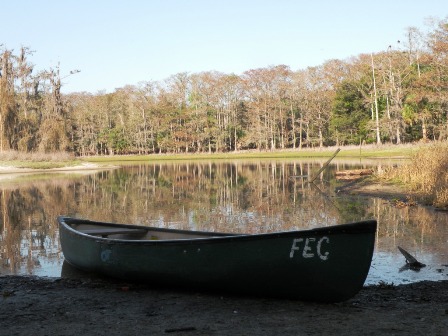
Regulations & Safety
Those who use a canoe or kayak should be aware that the
minimum safety requirements apply to them just like any other vessel. A wearable life jacket for each person on board and some sort of
efficient sound producing device (such as a plastic whistle) are
required by both U.S. Coast Guard and state law. In addition, navigation
between sunset and sunrise requires that a white light is available, and
is to be displayed in sufficient time to avoid a collision. The
requirements for vessel registration will apply to any canoe or kayak
that is propelled by mechanical means (electric or gas motors).
Canoe
Capsizing
If you capsize, float on the upstream
side of the canoe.
- You can be crushed on the downstream side if you run into an
obstruction.
- Do not attempt to stand or walk in swift moving water. A foot could
become entrapped between submerged rocks and the current can pin you
under.
- Float on your back with your feet and arms extended. Float with your
feet pointed downstream to fend off rocks. Don't fight the current. Use
the current to backstroke your way to shore.
Getting In and Out of a Canoe
You can quickly and easily master
getting into and out of a canoe without getting wet if you remember the
following important points:
- Keep your center of gravity low, and move slowly and deliberately.
- Transfer your weight slowly from shore to the bottom center of the
canoe.
- Board your canoe directly into your paddling position whenever
possible.
- For maximum control and stability always kneel in canoes, even
though some canoes have seats.
- To get out of a canoe, simply reverse the steps described above.
Safety Tips
Paddlers need to follow the same safe practices as any other small boat
operator. When paddling, you should:
- Know how to paddle or swim in tremendous currents and be an
experienced swimmer. Use the proper
safety
equipment & clothing.
- Never paddle alone. Two canoes
with two canoeists each is recommended. Three canoes with two
canoeists each is even better.
- Do not overload the canoe; tie down gear; and distribute weight
evenly.
- Check your canoe for leaks.
- Carry the proper
charts
& maps. Map a general route and timetable when embarking
on a long trip. Arrange for your vehicles to be shuttled to the
takeout.
- When approaching rapids or low head dams, go ashore well upstream
and check them out before continuing. Be aware of any dangers ahead.
Steer clear of drop offs and dams. Carry your craft around low head
dams.
- Stay away from strainers. Strainers are river obstructions that
allow water to flow through, but which block people and boats and
could throw you from the boat, damage it, or trap your craft.
Strainers may be found in the form of overhanging branches, log jams
or flooded islands.
- If canoeing on a lake, watch the weather and stay close
to shore. Head for shore if the waves increase.
- If the water is cold, take all necessary precautions to avoid
hypothermia.
|