 |
|
|
Home | Boating | Fishing | Diving | Water Sports | Boating Safety | Environment | Weather | Photo Gallery | Add Your Company to the Directory |
| You Are Here > Home > Boating > Boating Regulations |
|
Did You Know? Florida law requires anyone 21 years old or younger to take an approved boating safety course and earn a boating safety ID care to operate a boat with 10 horsepower or more. Boaters 21 and under must carry the ID card and a photo ID while operating a powerboat or personal watercraft. Florida Online Boating Safety Course and Exam This online boating safety course is approved by the Florida Fish & Wildlife Conservation Commission. Successfully completing this course will allow you to obtain the official Florida Boating Safety Education ID Card.
Vessel
Registration Vessels must be registered and numbered within thirty (30) days of purchase. Registration numbers must be displayed on the forward half of the vessel on both sides above the waterline. The numbers must be bold block letters at least 3 inches high in a color contrasting to the hull. The vessel registration decal must be renewed annually and is to be displayed within six (6) inches of, either before or after, the registration numbers on the port (left) side. Documented vessels without a state registration in full force and effect, must also obtain a Florida registration and display the validation decal on the port side of the vessel when using Florida waters.
Reckless And Careless Operation All operators are responsible for operating their vessel in a reasonable and prudent manner with regard for other vessel traffic, posted restrictions, the presence of a divers-down flag, and other circumstances so as not to endanger people or property. Failure to do so is considered careless operation (a non-criminal infraction). A violation of the Federal Navigation Rules is also a violation of Florida law. Mandatory Violator EducationFlorida law requires that anyone convicted of a criminal boating violation, a non-criminal boating infraction which resulted in a boating accident, or two non-criminal boating safety infractions within a 12-month period, must enroll in, attend, and successfully complete a NASBLA/state approved classroom boater education course. Correspondence or on-line course applications do not meet these requirements. Anyone who is convicted of a criminal boating violation, any boating infraction resulting in a reportable boating accident, or two non-criminal boating safety violations within a 12-month period must attend and successfully complete an approved boating safety course and file proof with the Florida Fish and Wildlife Conservation Commission. The violator's privilege to operate a vessel in the state will be suspended until proof of course completion is filed.
Water
Sking Regulations No one may ski or aquaplane between the hours of a half hour past sunset to a half hour before sunrise. No one may water ski or use another aquaplaning device unless they are wearing a U.S.C.G. approved non-inflatable Type I, II, III, or V personal flotation device (PFD). Inflatable personal flotation devices are prohibited. No one may ski or use another aquaplaning device while impaired by alcohol or other drugs. The operator of a vessel towing a skier may not pull the skier close enough to a fixed object or another vessel that there is risk of collision.
Diver Down Flag Divers must make reasonable efforts to stay within 300 feet of a divers-down flag in open waters (all waterways other than rivers, inlets, or navigation channels) and within 100 feet of a flag within rivers, inlets, or navigation channels. Vessel operators must make a reasonable effort to maintain a distance of at least 300 feet from divers-down flags on open waters and at least 100 feet from flags on rivers, inlets, or navigation channels. Vessels approaching divers-down flags closer than 300 feet in open water and 100 feet in rivers, inlets, and navigation channels must slow to idle speed.
Liveries (Boat/PWC Rental Facilities) The facility must provide pre-rental or pre-ride instruction on the safe operation of the vessel with a motor of 10 horsepower or more. This instruction must include, at a minimum, operational characteristics of the vessel, safe operation and right-of-way, operator responsibilities, and local waterway characteristics. The person delivering this information must have completed a NASBLA/state-approved boater safety course. All renters are required by law to have a boater education ID card must have the card or its equivalent before the facility may rent to them. The livery must display boating safety information in a place visible to the renting public in accordance with FWC guidelines. PWC liveries must provide on-the-water demonstration and a check ride to evaluate the proficiency of renters. PWC liveries may not rent to anyone under the age of 18. PWC liveries must display safety information on the proper operation of a PWC. The information must include: propulsion, steering and stopping characteristics of jet pump vessels, the location and content of warning labels, how to re-board a PWC, the applicability of the Navigation Rules to PWC operation, problems with seeing and being seen by other boaters, reckless operation, and noise, nuisance, and environmental concerns.
Manatee Awareness
|
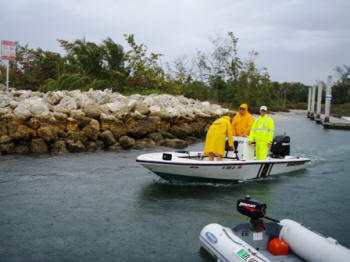
Boating Accidents It is unlawful for any person operating a vessel involved in a boating accident to leave the scene without giving all possible aid to the involved persons and without reporting the accident to the proper authorities.
Vessel
And Speed Restrictions Any vessel operating in a speed zone posted as "Slow Down - Minimum Wake" must operate fully off plane and completely settled in water. The vessel's wake must not be excessive nor create a hazard to other vessels.
Boating Under The Influence In Florida, a vessel operator is presumed to be under the influence if their blood or breath alcohol level is at or above .08. Any person under 21 years of age who is found to have a breath alcohol level of .02 or higher and operates or is in actual physical control of a vessel is in violation of Florida law.
Personal Watercraft Regulations See all the Florida PWC Safety Rules and Regulations here.
Mooring To Markers Or Buoys
Interference With Navigation Equipment And Lighting
Requirements A child under the age of six (6) must wear a U.S.C.G. approved Type I, II, or III personal flotation device while onboard a vessel under 26 feet in length while the vessel is underway. "Underway" is defined as anytime except when the vessel is anchored, moored, made fast to the shore, or aground. The use of sirens or flashing, occulting, or revolving lights is prohibited except where expressly allowed by law.
Maximum Loading And Horsepower
Marine Sanitation Devices
Muffling Devices The use of cutouts is prohibited, except for vessels competing in a regatta or official boat race and such vessels while on trial runs.
Law Enforcement Authority A law enforcement officer may stop any vessel for the purpose of checking for compliance with boating safety equipment requirements. Sea Grass Awareness Sea grasses are the principal food for endangered marine herbivores such as manatees and green sea turtles, act as natural filters to help purify the water, and provide a suitable environment for a wide variety of marine life. Boaters should make all available attempts to avoid running through sea grass beds. Navigation charts identify sea grass beds as light green on the chart. Boaters should make all possible attempts to stay within channels when unfamiliar with a waterway. Avoid taking shortcuts through sea grass beds to avoid causing propeller scars. It is a violation of Florida law to damage sea grass beds in some areas within state waters. Learn more about sea grass in Florida. Visit our page on Sea Grasses to learn more and see photos! |


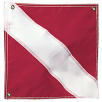 The
size of divers-down flags displayed on vessels must be at least 20
inches by 24 inches, and a stiffener is required to keep the flag
unfurled. Dive flags carried on floats may still be 12 inches by 12
inches. Also, divers-down flags on vessels must be displayed above
the vessel's highest point so that the flag's visibility is not
obstructed in any direction.
The
size of divers-down flags displayed on vessels must be at least 20
inches by 24 inches, and a stiffener is required to keep the flag
unfurled. Dive flags carried on floats may still be 12 inches by 12
inches. Also, divers-down flags on vessels must be displayed above
the vessel's highest point so that the flag's visibility is not
obstructed in any direction.
|
Privacy Policy |
Advanced
Search
|
Add Your
Company To The Directory
|
Contact Us
|
Advertise |